
APG has been appointed Passenger General Sales Agent (GSA) for China Southern Airlines in Ethiopia, supporting the airline’s commercial development in the Ethiopian market.
Through this appointment, APG’s local team will support passenger sales development and provide assistance to travel agents and travel trade partners across Ethiopia. The team will work closely with China Southern Airlines to strengthen its local presence and develop business opportunities.
The appointment comes as China Southern Airlines expands its presence in Africa, following the recent launch of its twice-weekly service linking Addis Ababa and Guangzhou via Changsha. The service provides additional travel options between Ethiopia and China, supporting business, leisure and visiting friends and relatives travel.
With local market expertise and established travel trade relationships, APG Ethiopia will help raise awareness of the airline’s services and support trade partners in promoting the route to their customers.
APG looks forward to working with China Southern Airlines and the Ethiopian travel trade to develop passenger sales and support travel between the two countries.
For more information about APG Passenger GSA services, visit our Passenger GSA Services page.
Not so long ago, Turkey was insignificant in the aviation landscape. Only its national airline, Turkish Airlines (Turk Hava Yollari Anonim Ortakligi), flew the national flag, and its reputation was unremarkable at best, tarnished by a crash in the forest of Ermenonville, north of Paris. It was, if I’m not mistaken, in 1974. Since then, things have changed a lot.
It began with the appointment of Temel Kotil as head of the company in the early 2000s. Kotil, strongly supported by his government, gave the airline a new lease of life. This coincided with a period when the Gulf airlines, particularly Emirates, had demonstrated that a very good product based on high-quality airport facilities could attract passengers who were quite willing to take a connecting flight through a well-equipped hub.
All that remained was for Turkey to develop such a hub. However, Istanbul’s historic airport quickly reached capacity and could not accommodate its national carrier’s ambitious growth plans. The decision to create a new airport was the real trigger for Turkish aviation growth. It must be said that the country did not pull any punches. The new facilities at Ataturk Istanbul airport were designed to handle 150 million passengers, twice the capacity of Paris Charles de Gaulle airport, then Europe’s largest airport. Of course, developing such a complex required a vast area of land, so it had to be built a considerable distance from Istanbul. But this did not deter the project’s backers, and the bet paid off.
With this new hub, the company could envisage strong growth by following the strategy of the Gulf operators, who had demonstrated the success of a connecting-flight model, provided they offered a very large number of destinations and an airport layout designed to facilitate connections. The arrival of this new hub on the world market coincided with the Asian wave, and the Turkish national airline was up to the task, not only by expanding its services but also by offering good value for money. The company now has 499 aircraft, 97 of which are operated by its subsidiary AJet, and carried more than 85 million passengers in 2025.
In the wake of the historic carrier, new operators have appeared: SunExpress, which has joined forces with the Lufthansa group, and Pegasus Airlines, two low-cost carriers that have largely made their mark in Europe.
Istanbul airport has already secured a major place in international air transport, broadly comparable to the established hubs of the Gulf. These are currently severely affected by a geopolitical situation whose damaging consequences they are suffering despite having played no part in creating it. This has contributed to the prosperity of Turkish airlines, although we can hope for a return to political calm in the Gulf.
We are now seeing a Turkish push into the European market, with the takeover of Czech Airlines by Pegasus Airlines, which is also targeting the Hungarian Smartwings. This is a new development and demonstrates, if further proof were needed, the strength of Turkish airlines and their ambitions in the European market. This strongly resembles Turkey thumbing its nose at the European authorities, who are, to say the least, dragging out its accession to the European Community.
Air transport has become a peaceful weapon for expanding the influence of a country that dreams only of regaining the dominant position of the Ottoman Empire. This demonstrates the importance of air transport, not only for developing economic and cultural exchanges but also for gaining considerable influence over certain large geographical regions without the use of destructive weapons.
European countries do not seem to have taken into account the advantages they could derive from a powerful air transport industry, judging by the fiscal and ecological measures all intended to weaken an industry that is nevertheless so valuable, as Turkey can demonstrate.
APG has been appointed as Passenger General Sales Agent (GSA) for Chalair in Spain and Andorra.
APG is pleased to announce its appointment as Passenger General Sales Agent (GSA) for Chalair in Spain and Andorra, further strengthening its partnership with the French regional airline.
Under this agreement, APG will manage sales and marketing activities across both markets, working closely with travel agencies and distribution partners to raise awareness of Chalair’s services and identify new commercial opportunities.
Through its local market expertise and established travel trade relationships, APG will support Chalair in expanding its commercial reach and strengthening engagement with the Spanish and Andorran travel sectors.
Building on an established relationship, this appointment reflects a shared commitment to developing Chalair’s presence and supporting the continued growth of its regional network. APG looks forward to this next chapter of the collaboration.
For more information about APG Passenger GSA services, visit our Passenger GSA Services page.
Annual conference will explore “Navigating Change, Unlocking Growth” on 4–6 November 2026.
The World Connect conference will bring together airline executives, aviation specialists and travel industry leaders from around the world for its 17th edition, taking place at the Fairmont Monte Carlo in Monaco from 4 to 6 November 2026.
Organised annually by APG, World Connect has developed into an established international meeting point for the airline and aviation community. Over successive editions, the conference has built a reputation for bringing senior decision-makers together to exchange perspectives, strengthen business relationships and discuss the forces shaping the industry.
This year’s edition is expected to welcome approximately 500 delegates, including 119 airline CEOs and senior airline executives, with 59 airlines and 85 countries represented. This international participation reflects World Connect’s standing as an established meeting point for aviation industry leaders.
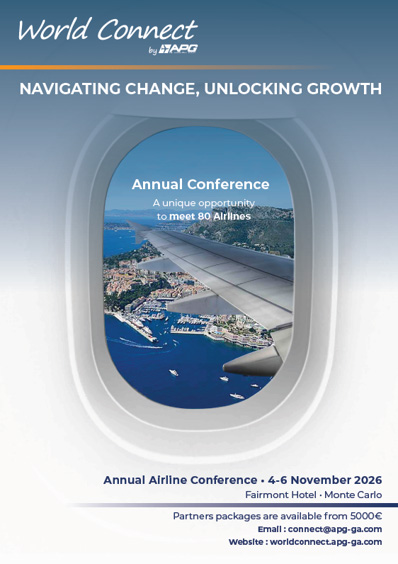
Under this year’s theme, “Navigating Change, Unlocking Growth,” keynote speakers and panellists will examine how aviation businesses can respond to disruption, strengthen commercial resilience and identify new opportunities for growth.
The programme will address key priorities across the sector, including strengthening customer loyalty through distribution and technology; protecting airline connectivity and revenue amid geopolitical uncertainty; and building a stronger commercial aviation industry. Discussions will also explore how innovation is influencing fleet strategies, operational efficiency and the passenger experience. Among the speakers featured in this year’s programme are Roberto Alvo, CEO of LATAM; Luís Rodrigues, CEO of TAP Air Portugal; Lemma Yadecha Gudeta, CEO of Ethiopian Airlines, and Maarten Koopmans, Managing Director of KLM Cityhopper.
Keynote contributions from aviation executive Pieter Elbers and astrophysicist Patrick Michel, Principal Investigator of ESA’s Hera mission, will broaden the discussion to encompass aviation’s future opportunities and the potential of scientific discovery to drive change.
Alongside the conference sessions, World Connect will offer opportunities for delegates to meet, share expertise and develop relationships through its Business Connect sessions and networking events.
As aviation continues to navigate a changing global environment, the 17th edition of APG World Connect will provide a forum for industry leaders to consider shared challenges and the partnerships, strategies and ideas that can support future growth. For the programme and further information, visit worldconnect.apg-ga.com

I am certainly not a great scientist or a forecasting specialist, but that does not prevent me from asking myself what aircraft we will need over the next two decades. We face two contradictory certainties. On the one hand, passenger numbers will double by 2040, everyone agrees on that. On the other, we will have to achieve carbon neutrality by 2050, as announced in 2012 by Giovanni Bisignani, then CEO of IATA. This goal has never been called into question since, even though it seems impossible to achieve. Meeting this enormous challenge will certainly require new aircraft to be brought to market.
The major manufacturers, Boeing and Airbus, are undoubtedly exploring the issue. Yet we have the impression that they are in no hurry, probably because their current aircraft ranges sell easily and their production processes are well established. In other words, the big two make so much money from existing aircraft that they feel no urgency to develop new models. And yet we will need them.
To carry the approximately 10 billion passengers expected in the next 10 to 15 years, we will first need very large aircraft capable of carrying 1,000 passengers. Merely mentioning this figure is enough to be met, at best, with derision. And yet, what would people have said in 1960 about anyone who envisaged aircraft with more than 300 seats capable of crossing oceans, when the iconic Boeing 707 had only just entered the market, carrying just 110 passengers with a very limited range? We will have to make a comparable leap, moving from aircraft accommodating around 350 passengers, I am thinking of the Airbus A350 or the Boeing 777 in their various versions, to aircraft with 1,000 seats. If we do not, we will have to triple the number of flights, which would be unacceptable to people living near airports. Nor can the number of airports increase indefinitely, unless we build enormous facilities in very sparsely populated areas. These would then have to be connected to major cities through substantial investment in ground transport links.
The environmental challenge adds another layer of complexity to accommodating this growth. One very large aircraft would do the same job as three of today’s large-capacity aircraft. It is also difficult to see how air traffic could be managed if the number of flights tripled. This raises the question of how these new aircraft will be powered. The answer has yet to be found. Of course, sustainable aviation fuel (SAF) offers part of the solution, but it appears to have its limits. We are still searching for the technological breakthrough that will provide the answer.
We are beginning to see significant progress in electric propulsion. For now, experts describe it as unrealistic because it cannot provide enough power to get aircraft off the ground, even if it can be used once they reach altitude, as Bertrand Piccard demonstrated with Solar Impulse. But until the end of the 19th century, similar doubts surrounded the possibility of heavier-than-air machines flying while carrying passengers. We have to trust researchers. Of course, we are always impatient to see their work bear fruit, and we are reluctant to fund it until we are certain it will succeed. But we must accept that failure is part of the path to success.
Then there is the development of high-speed rail. The TGV, introduced in France in the mid-1970s on the Paris–Lyon route, has since been followed by the widespread expansion of high-speed rail across Europe, where distances lend themselves to its use. Similar developments can be seen in Asia, beginning with Japan and now China, as well as in the Emirates and the United States. In regions such as California and Texas, some major cities are close enough together to justify building and operating fast trains as an alternative to flying. Morocco is acquiring such systems, Russia is doing the same, and Chinese companies are building new railway lines across Asia. This could offer a promising way to accommodate the anticipated growth in travel demand.
The fact remains that research in air transport will have to be funded, and the cost will be borne mainly by consumers, in other words, passengers. We should therefore expect fares to continue rising.
APG has been appointed as Passenger General Sales Agent (GSA) for Akasa Air in Malaysia.
APG is pleased to announce its appointment as Passenger General Sales Agent (GSA) for Akasa Air in Malaysia.
Through its local team, APG will support Akasa Air’s commercial development in the Malaysian market, strengthening engagement with travel agents and raising awareness of the airline’s network and services.
The appointment combines APG Malaysia’s local market expertise and established trade relationships with APG Network’s global reach, helping Akasa Air develop new sales opportunities and strengthen its presence in the market.
For more information about APG Passenger GSA services, visit our Passenger GSA Services page.
APG Airlines is pleased to welcome Hunnu Air to its growing network of interline partners, further expanding ticketing options for travel agents.
Based in Mongolia, Hunnu Air operates from its main hub at Ulaanbaatar Chinggis Khaan International Airport (UBN), serving domestic destinations and connecting Mongolia with key markets across Asia, including China, Kazakhstan and India.
The addition of Hunnu Air marks APG Airlines’ second airline partnership in Mongolia, reflecting our continued commitment to expanding our global network and developing new opportunities for the travel trade.
Through this partnership, Hunnu Air joins the APG Airlines network, extending the range of airline options available to travel professionals within the scope of the agreed distribution and ticketing arrangements.
APG Airlines is delighted to welcome Hunnu Air to its growing partner network and looks forward to developing a successful and lasting partnership.
For more information, visit APG Airlines
I have before me a few extracts from Amadeus showing the fare lists of certain carriers. I do not intend to name them here because, in any case, regardless of which companies are examined, they all follow the same practices. I would simply like to demonstrate the absurdity of this way of operating.
On major international routes, such as the northern and southern transatlantic routes, the battle is fierce. Admittedly, in “business” class, fares are closer together because carriers aim to maximise high-contribution revenue. Nevertheless, ten options are displayed, and the difference between the highest and lowest fares is around 30%, which is still reasonable.
On the other hand, when you move down to the lower classes, “premium economy” or “economy”, you cannot help but be surprised by the ingenuity of the “yield managers”. In “premium economy”, there are around twenty one-way fares and slightly fewer round-trip fares, yet the differences between them can still be as much as two to one. Where creativity really comes into its own, however, is in the very ordinary economy class. The route managers have clearly had a field day.
On the North Atlantic route, taking the same flight on the same day, I found 22 one-way fares and no fewer than 109 round-trip fares, ranging from €2,902 to … €200 for a round trip. The differences are somewhat smaller on the South Atlantic route, which merely suggests that there is less competition there. I also note that on the Los Angeles–Honolulu route, no fewer than 200 fares, ranging from one extreme to the other, are displayed by four carriers.
In short, I have been wondering for years how such aberrations can be justified. Why is it useful to have more than 100 different fares for the same flight, in the same class of service, on the same day? More fundamentally, what is the point of displaying so many fares? I am surprised that carriers continue to pay for advertising campaigns promoting prices that clearly do not cover their costs. Below €50 or $50 per hour of flight, making a profit is impossible. In other words, offering round-trip fares of less than €500 on transatlantic routes amounts to selling at a loss and, if I am not mistaken, this practice is prohibited. Yet it continues with remarkable consistency.
The consequences are far from trivial. Displaying, and even promoting, extremely low fares devalues the noble and complex activity that is air transport. It creates the impression in the public’s mind that flying an aircraft across the oceans for more than ten hours, in acceptable conditions of comfort and complete safety, at a speed of 900 km/h, is worth virtually nothing. I find that sad. And when customers come to buy their tickets, they are often surprised to discover that the fare they were promised is nowhere to be found and that the actual price is much higher, reflecting what it costs to provide the service. In other words, airlines pay for advertising campaigns that devalue both their product and themselves.
It is certainly normal for different fare levels to exist depending on when a ticket is purchased. This has always been the case, even when fares were regulated through IATA agreements. But why this avalanche of fares? Why have airfares become so incomprehensible? Can we not return to a little common sense?
As far as I know, other sectors, such as the catering industry, have always maintained a relationship between their prices and the services they provide. Hoteliers are increasingly following the example of air transport, while rail operators are not missing out on the trend either. But can this really be considered progress?
On the other hand, we are witnessing a return to quality of service. This is particularly true of European carriers, which, since the end of the Covid pandemic, have begun to recover the excellence they displayed in the 1970s, before the major decline of the 1990s, when “low-cost” carriers began to make their presence felt in force.
I am also pleased to note that European airlines are beginning to climb back up the Skytrax rankings. Air France has entered the top ten in seventh place, while Lufthansa is in 14th place, Iberia in 16th, and Swiss in 19th. For years, no European airline appeared in the top 20. This is a good sign, a very good one. Air France has even taken first place in the First Class category.
Let us not despair. Perhaps the quality of the product will finally be recognised as the key element in air transport marketing, and carriers will compete on the strength of their service rather than through the advertised reduction of fares, even when those reductions are artificial.
In 2025, according to the latest available global figures, air transport generated a turnover of $1,008 billion, or $2.76 billion per day or $115 million every hour, across some 1,300 scheduled airlines. We will pass the 5 billion passenger mark in 2026. And the system continues to grow by 4% to 5% per year, which means a higher traffic volume of around 250 million passengers from one year to the next. More than 25,000 planes are used to transport all these people.
How did we get to this point?
Air transport has enjoyed such popularity for at least three good reasons, each of which is a determining factor. First of all, there is the desire of the inhabitants of the planet to travel: it is the expression of the freedom to be able to go from one country to another, even if obtaining the necessary visas can limit the possibilities. Secondly, it is the extraordinary technological development that has had the effect of making this type of transport more accessible while ensuring reliability close to perfection. And then there is the highly intelligent organization of the marketing of this activity, thanks to a unique distribution system.
The management of marketing criteria and distribution tools is the work of IATA. This organization (International Air Transport Association) was founded in Havana in April 1945, i.e. before the end of the Second World War. From that moment on, the founders immediately recognized that passengers might need to travel using several carriers during the same trip. This was all the more true since the range of aircraft was infinitely shorter at the time than it is today. It was therefore necessary to find a way to simplify the formalities and avoid having to buy a separate ticket for each carrier used. This is how the concept of “interline” came into being.
On paper, it seems very simple and even obvious. In fact, it consists of the companies agreeing to carry passengers with a ticket issued by another carrier. This is elementary, except that the money that comes in return for the purchase of the ticket is received by the issuing company. It was therefore necessary to ensure the correct transfer of the share due to the companies that transport the customer on a single part of the journey. For this to happen, the companies also had to have a great deal of trust in each other and agree to collaborate, even, and above all, I would say, with their competitors. For example, a passenger could make a round trip between New York and London with an American Airlines ticket, while flying with American Airlines in one direction and BOAC in the other.
This organization has been the basis of the success of air transport. I will pass over the complexity of the administrative process, which must both respect the decisions of each carrier and ensure the reliability of the flow of funds while guaranteeing passengers a smooth journey. This system has survived 80 years of history and the dazzling development of this activity. It has been adopted by almost all carriers, and even the “low-cost” carriers are beginning to adopt it. To my knowledge, there is no equivalent in other sectors of activity, except perhaps in telecommunications.
It remained to improve the lives of distributors—travel agents—who had long been very dominant in the distribution of air transport before the arrival of the Internet and the possibility for customers to buy their tickets directly from their carrier. This is why IATA created what is known as the BSP (Billing and Settlement Plan). Before the BSP, each airline had to deposit a stock of tickets in each travel agency it wanted to accredit. This required the latter to keep a rigorous inventory of these stocks, of which it could hold as many as there were carriers. The concept of the BSP consists of holding only one stock of tickets managed by IATA and assigning each ticket issued to the carrier chosen by the travel agent.
At the end of the agreed period, IATA deducts the amount of the tickets issued minus the distributor’s commissions and distributes the total among the carriers designated by the travel agents. This has not only simplified the management of both distributors and carriers, but it has also made financial payments more reliable. Its widespread adoption has not been easy; it has taken half a century from the first BSP introduced in Japan in 1971 to its adoption in nearly 150 countries.
Of course, everything that was manual has been computerized and digitized, but the concepts remain as defined when they were created.
To give an idea of the scale, the total amount of payments that passed through IATA was $492.4 billion in 2025, with an unpaid-bill rate of less than 0.05%. Hats off to those behind it!
APG Airlines is pleased to welcome Sun PhuQuoc Airways to its growing network of interline partners, further expanding ticketing options for travel agents.
Part of Vietnam’s Sun Group, Sun PhuQuoc Airways places the island of Phu Quoc at the heart of its approach, connecting air travel with the group’s wider tourism and hospitality offering.
Through this new partnership, travel agents can issue Sun PhuQuoc Airways tickets on APG Airlines GP-275 stock via their preferred GDS, giving them more choice when planning journeys to Vietnam.
We are delighted to welcome Sun PhuQuoc Airways to the APG Airlines network and look forward to supporting the airline’s growth in international markets.
For more information, visit APG Airlines


