• Link to LinkedIn
  • Link to Facebook
  • Link to X
  • Link to Youtube
APG Air Promotion Group
  • Home
  • About
      • About Us
      • Read about APG Network, what we offer, our partnerships and getting connected.

      • About APG
      • Our Clients
      • Service Partners
      • Chronicle of Jean Louis Baroux
      • Environmental, Social and Governance
      • APG Team
      • Our global leadership, governance and ownership explained

      • Our Team
      • Presidents & Secretary General
      • Regional VPs
      • Other Board Members
      • Executive Product Directors
      • Our Story
      • Learn about APG’s origins and evolution from 1991 to-date.

      • Our Story
      • APG Academy
      • World Connect
      • Connect with APG
  • Team
    • APG TEAM
      • With over 20 years in the airline distribution market, APG is the world’s largest and most successful passenger and cargo GSA airline representation network.

        APG is headquartered in Paris with a central Commercial Team and a Board, headed by the President of the network and including one Vice President per major world geographical area plus one Executive Product Director per product.

        Our Executive Product Directors bring innovation, expertise, and dedication to each product we offer.

        Our people are what make the difference.
      • Our Team
      • Our Product Directors
      • Our Global Offices
      • Connect with APG
      • "I always wanted APG to become an example of doing business differently.
        We bet everything on people, Humans
        The Difference Is People"
        Sandrine De Saint Sauveur
        President & CEO APG Inc


      • "APG operates with a highly efficient worldwide management team with experience in many disciplines and extensive expertise in their fields.
        Reporting lines are short to ensure quick decision making in a fast-changing world."
        Richard Burgess
        President APG Network
  • Locations
      • With over 100 offices covering over 170 countries, APG is the world’s largest and most successful passenger and ​cargo GSA airline representation network. *Countries in orange represent Passenger & Cargo
      • AMERICAS
      • Argentina
      • Bolivia
      • Brazil
      • Canada
      • Central America
      • Chile
      • Colombia
      • Costa Rica
      • Dominican Republic
      • Eastern Caribbean
      • Ecuador
      • Jamaica
      • Mexico
      • Nicaragua
      • Panama
      • Paraguay
      • Peru
      • Uruguay
      • USA
      • EUROPE
      • Albania
      • Armenia
      • Austria
      • Azerbaijan
      • Belgium & Luxembourg
      • Bulgaria
      • Cyprus
      • Czech Republic
      • Denmark
      • Finland
      • France
      • Germany
      • Georgia
      • Greece
      • Hungary
      • Ireland
      • Italy
      • Kazakhstan
      • Malta
      • Netherlands
      • Norway
      • Poland
      • Portugal
      • Romania
      • Serbia
      • Slovenia
      • Spain
      • Sweden
      • Switzerland
      • Türkiye
      • Ukraine
      • United Kingdom
      • Uzbekistan
      • MIDDLE EAST & AFRICA
      • Benin
      • Burkina Faso
      • Cameroon
      • Djibouti
      • Egypt
      • Ghana
      • Guinea
      • Iraq
      • Israel
      • Ivory Coast
      • Jordan
      • Kuwait
      • Kenya
      • Lebanon
      • Madagascar
      • Mali (CWA)
      • Mauritania
      • Mauritius
      • Morocco
      • Mozambique
      • Niger
      • Nigeria
      • Qatar
      • Rwanda
      • Saudi Arabia
      • Senegal
      • South Africa
      • Togo
      • Tunisia
      • UAE
      • Yemen
      • Zambia
      • ASIA PACIFIC
      • Afghanistan
      • Australia
      • Bangladesh
      • Brunei
      • Cambodia
      • China
      • Hong Kong
      • India
      • Indonesia
      • Japan
      • Malaysia
      • Maldives
      • Mongolia
      • Nepal
      • New Zealand
      • Pakistan
      • Philippines
      • Singapore
      • South Korea
      • South Pacific – Fiji
      • Sri Lanka
      • Thailand
      • Vietnam
  • Services
      • APG Services
      • APG is a global leader in airline distribution, offering a unique blend of passenger and cargo services tailored to meet the needs of over 200 airline clients worldwide.

        With an innovative approach and extensive expertise, APG goes beyond traditional GSSA services to provide comprehensive solutions that drive revenue growth and optimize operational efficiency.

        Whether through cutting-edge passenger distribution tools or dynamic cargo sales strategies, APG delivers unparalleled support to help airlines thrive in competitive markets.

      • Passenger
      • Passenger GSSA
      • APG Airlines
      • APG Airlines PLUS
      • APG Direct Connect – Airlines
      • APG Direct Connect – Travel Agents
      • APG Settlement Services
      • APG Fare Filing
      • Cargo
      • Cargo GSSA
      • ​Cargo Interline Solution

      • This section is also available in the following languages:

      • Francais
      • 中文
      • Português
      • Español
  • News
    • APG News
      • The latest from APG Network


      • Latest News
      • Contact Media Relations
      • Connect with APG
    • Chronicles of Jean Louis Baroux
      • Jean-Louis Baroux is a distinguished expert in the airline and travel industry, bringing over 55 years of experience to the field.


      • About Jean Louis Baroux
      • Latest Chronicles
  • Contact
      • We’d love to hear from you…
        Get answers to your questions or send us your feedback, however you like to get in touch. Choose from the following options and we will direct your enquiries to the right place, quickly and easily.
      • Find an APG office

        With over 100 offices covering more than 170 countries in the Americas, Europe, Asia Pacific, Middle East & Africa, APG is the world’s largest and most successful passenger and ​cargo GSA airline representation network.

      • Passenger Offices
      • Cargo Offices
      • Find an Expert

        Meet the experts behind APG’s industry-leading solutions. Connect with our Executive Product Directors, who bring innovation, expertise, and dedication to each product we offer.

      • Our team
      • Executive Product Directors
      • Regional VPs
      • Contact Us

        Submit your query via our online form and this will be directed to the right location.

      • Submit Online Query

      • Head Office:
        APG Network
        66 avenue des Champs Elysees
        75008 Paris
        France

      • Contact Media Relations
      • Connect with APG
      • Report a technical issue
  • Click to open the search input field Click to open the search input field Search
  • Menu Menu
  • Home
  • About
    • Our Story
    • Our Clients
    • Partners
    • Environmental, Social and Governance
    • Chronicle of Jean Louis Baroux
  • Our Team
  • Locations
  • Services
    • Passenger
      • Passenger GSSA
      • APG Airlines
      • APG Direct Connect – Airlines
      • APG Direct Connect – Travel Agencies
      • APG Settlement Services
      • APG Airlines PLUS
      • APG Fare Filing
    • Cargo
      • Cargo GSSA
      • ​Cargo Interline Solution
    • Francais
    • 中文
    • Español
    • Português
  • News
  • Contact

Does Europe Want To Kill It’s Air Transport?

All, chronicles

We may ask ourselves this question given the constraints imposed by the European Union but also directly by European states on their air transport. Long gone are the days when this activity was the pride of the continent. Between the 1960s and 1980s, European companies represented the jewel of the Old Continent, which was in the process of rebuilding itself after having spent centuries in internal struggles that almost destroyed it. It was the time when the national carriers: Air France, Lufthansa, British Airways, Alitalia, SAS, KLM and so on had developed the world’s leading international network, far ahead of even the United States, which was largely concentrated on its domestic space. Times have changed. Traditional operators have not been able to manage the arrival of “low-cost” carriers, which they saw as enemies instead of considering them as fantastic market developers. Let’s face it, airlines were the first to create their own difficulties.

But as they struggled with new low-cost competitors, government authorities, instead of helping them, continued to slow down their expansion. The first difficulty came in the contest of airspace management. The latter is fragmented by its geopolitical geography, each state being the owner of its aeronautical environment. While it has been possible to create a single currency whose benefits cannot be over celebrated, it has been impossible to create and manage a common civil airspace until now. The design of air routes no longer matches aircraft capabilities, and the loss of time is estimated at 8 minutes on average per flight, which is also an aggravating factor for fuel consumption and CO₂ emissions. In addition, the entire European area is penalised every time an air traffic control strike affects any of the states. One may wonder why governments and the European Commission have not managed to address this difficulty, even if it must be admitted that it is not easy.

Ecological pressure has also taken hold of governments, and they, through a curious demagogy, have placed the burden on air transport, which is accused of all evils, even though it is one of the few activities that has become aware of the importance of achieving carbon neutrality. Instead of supporting the necessary transition, the response of the political authorities has been to force operators to reduce their offer, without having consulted consumers for their opinion. This is why some airports such as Amsterdam or London Heathrow, or even Paris Orly and others that I am forgetting, have had to reduce or cap the number of aircraft movements even though their facilities allowed them to be expanded. We have also seen states outright ban air services when rail allows them to be replaced in 2 hours and 30 minutes.

At the same time, new and important traffic rights were allocated to Gulf carriers, such as Qatar Airways. I note that the Gulf Emirates have clearly perceived the political and economic importance of supporting the development of their airlines. We cannot blame them for that, but we would have liked the European authorities to do the same instead of penalising them. I also note that the latest European regulation on air passenger rights will impose new obligations on airlines, if it is adopted by the European Parliament and the Council of the European Union.

It is paradoxical, to say the least, to see that everyone agrees that air transport should achieve carbon neutrality by 2050, which, by the way, is impossible without a technological leap that we do not see taking shape, and at the same time, that we are clipping the wings of this activity. The investments required to decarbonise the air industry are prodigious, probably several trillion dollars, and we will have to find the resources to finance them. Where can this money come from if not from air transport itself—in other words, from passengers who will have to accept serious increases in fares that will produce increased profits for carriers, a large part of which will have to be devoted to research to achieve environmental targets. For this to happen, European air transport will need not only the neutrality of governments but their support, not financial, but administrative.

Without strong cooperation between all the players in the aviation sector and the states that hold the regulations and air traffic control, it will not be possible to make sufficient progress. Everyone must take their responsibilities, first and foremost the European Commission.

25 June 2026
https://apg-ga.com/wp-content/uploads/2025/03/25apg-jlb-chronicle-inner-800.png 232 800 Jean-Louis Baroux https://www.apg-ga.com/wp-content/uploads/2025/03/25apg-logo-340x156-1.png Jean-Louis Baroux2026-06-25 21:09:162026-06-25 21:09:17Does Europe Want To Kill It’s Air Transport?

APG Appointed Passenger GSA for Ajet in Saudi Arabia

All, news
Published: 19 June 2026

APG is pleased to announce its appointment as Passenger General Sales Agent (GSA) for AJet in Saudi Arabia.

APG already supports AJet through its existing Passenger GSA partnership in Uzbekistan. This latest mandate extends the relationship into the Kingdom of Saudi Arabia, where APG will provide local sales and commercial representation services to support the airline’s growth and development in the market.

As Saudi Arabia continues to emerge as a key aviation and tourism hub, this new agreement reflects AJet’s commitment to strengthening its presence in the region while benefiting from APG’s local expertise and industry relationships.

The mandate further reinforces APG’s role as a trusted commercial partner for airlines worldwide, delivering market representation, sales support, and business development services through its extensive global network.

We are proud to continue building on our successful relationship with AJet and look forward to supporting the airline’s ambitions in Saudi Arabia.

For more information about APG Passenger GSA services, visit our Passenger GSA Services page.

Written by
Fredi Aravena
Digital Content & Communications

19 June 2026
https://apg-ga.com/wp-content/uploads/2026/06/Ajet-plane-hero.jpg 695 1800 Fredi Aravena https://www.apg-ga.com/wp-content/uploads/2025/03/25apg-logo-340x156-1.png Fredi Aravena2026-06-19 18:07:032026-06-19 18:15:02APG Appointed Passenger GSA for Ajet in Saudi Arabia

Where Will the Diversification of Airport Services Stop?

All, chronicles

There is a great constant in air transport: everyone complains. Manufacturers are unable to deliver their orders due to a lack of manpower, carriers cannot earn enough money, with a few notable exceptions, airports are constrained by their pricing agreements with airlines and customers, and finally passengers themselves are not happy with the services provided by the entire chain of operators in this sector of activity. This does not prevent air transport from continuing to grow steadily since the end of the Second World War, i.e. more than 80 years.

In the middle of this activity are the airports. It is the obligatory and almost monopolistic crossing point if you want to get to a city by plane. Their position is sufficiently protected that they can afford to set their prices without fear of competition. However, the airlines are reluctant to pay the fares requested and have managed to ensure that these fares are governed by agreements between the users, which are the carriers and the owners of the infrastructure, the companies managing the airports. However, this practice puts the latter in a state of fragility. They are obliged to finance the development of their technical and commercial facilities for long periods of time, while operators can at any time change their strategy and, for example, abandon services deemed unprofitable, which takes essential revenue away from airports.

So to overcome the uncertainties and find the resources necessary for their development, management companies have resorted to two strategic developments. Firstly, for the largest ones, to broaden their field of activity by taking control of airport platforms that are sometimes very far from their historical base, and thus create a network capable of balancing revenues in the event of difficulties at one of the airports managed. And then to diversify their service offer within their facilities. Based on the principle that a clientele with high purchasing power was forced to spend long periods of time, sometimes several hours, in their terminals, the major airports have created shopping malls that are sometimes very large and attract major commercial brands and bring in a very significant income, up to half of the revenues of the major “hubs”, while providing a fun occupation for passengers.

Of course, the airlines have complained because they believe that the customers of these new shopping centres belong to them and that they are entitled to claim a share of the profit it brings. Airports, on the other hand, are fiercely opposed to giving up anything, arguing that without this resource they would have to drastically increase their fees, which is unacceptable to the airlines, and the latter claim that they are the only players in the air transport chain to lose money. This balance in the allocation of commercial revenues is unlikely to be upset.

On the other hand, large airports have to face a new risk: the development of surface lanes. The great progress made in rail transport and ecological pressure naturally lead to a reduction in the number of vehicles using airport car parks, which are so profitable, and even to a reduction in the number of passengers, and therefore of aircraft movements for services of less than 3 hours of flight. The safety constraints imposed on air passengers and not on rail transport customers are not for nothing. So imagination starts to run, and airports start thinking about new services.

Always based on the principle that customers spend a lot of time in their facilities, that they have an above-average purchasing power and that they are not afraid to travel, the managers of these large airports are embarking on the activity of travel agencies, as has recently been announced by Aéroports de Paris. This can become dangerous for the profession of tour operators unless this service is provided by an agency that buys a concession in the airport concerned. But it is difficult to see how, given the low margins made by travel agencies and the operational risks of tour operators, it will be possible to levy fees on this activity.

Once this new service is launched, it is difficult to see where it could stop: why not banks or real estate agencies, what do I know? Imagination knows no bounds… except perhaps those of common sense.

18 June 2026
https://apg-ga.com/wp-content/uploads/2025/03/25apg-jlb-chronicle-inner-800.png 232 800 Jean-Louis Baroux https://www.apg-ga.com/wp-content/uploads/2025/03/25apg-logo-340x156-1.png Jean-Louis Baroux2026-06-18 21:17:282026-06-18 21:17:30Where Will the Diversification of Airport Services Stop?

APG at 35: A Journey of Growth, Innovation, and Connection

All, news

From six offices in 1991 to a global aviation network spanning more than 100 countries, APG celebrates 35 years of innovation, partnership, and connection.

In 1991, APG began with a simple but ambitious vision. Starting with six GSSA offices across Europe and Egypt, the company set out to provide airlines with strong local representation and global reach.

Thirty-five years later, APG has grown into a worldwide network of more than 100 offices, supporting airlines, travel professionals, and cargo partners across every major market. What began as a regional operation has evolved into a global aviation services group driven by innovation, adaptability, and strong human relationships.

As we celebrate our 35th anniversary, we reflect not only on how far we have come, but also on the values that continue to guide us forward.

Our Journey: Key Milestones

1991
APG Founded
Six GSSA offices.
1999
BSP Services
BSP solutions launched.
2005
ARC Services
ARC support added.
2006
Interline
IET launched.
2009
World Connect
Conference launched.
2016
APG Airlines
GP-275 code.
2017
Cargo
AWB 275 launched.
2018
Direct Connect
NDC platform.
Building a Global Aviation Network

Over the past 35 years, APG has continuously evolved to meet the changing needs of the aviation industry. What began as a small network of GSSA offices has grown into a global aviation services group supporting airlines, travel professionals, and cargo partners in more than 100 countries.

Through a combination of local expertise, global reach, and a commitment to innovation, APG has expanded its portfolio far beyond traditional airline representation. Today, the group provides a comprehensive range of services spanning distribution, interline solutions, airline and cargo representation, NDC connectivity, and industry events.

Jean Louis Baroux, founder of APG, signing airline partnership contracts during the company's early years.

This growth has been driven by a clear focus on helping airline partners access new markets, strengthen distribution channels, and build meaningful commercial relationships around the world. At the same time, APG has continued to invest in technology and new solutions that support the evolving needs of both airlines and travel professionals.

From pioneering distribution services to launching innovative connectivity solutions, APG’s journey has been defined by adaptability, collaboration, and a long-term commitment to supporting the global aviation community.

More Than Technology: APG at 35

While technology and innovation have played a major role in APG’s growth, the company’s success has always been built on people.

Throughout the years, APG has remained committed to maintaining a balance between experience and innovation. The knowledge, expertise, and dedication of long-standing team members continue to shape the company’s strength, while new ideas, technologies, and fresh perspectives help drive future development.

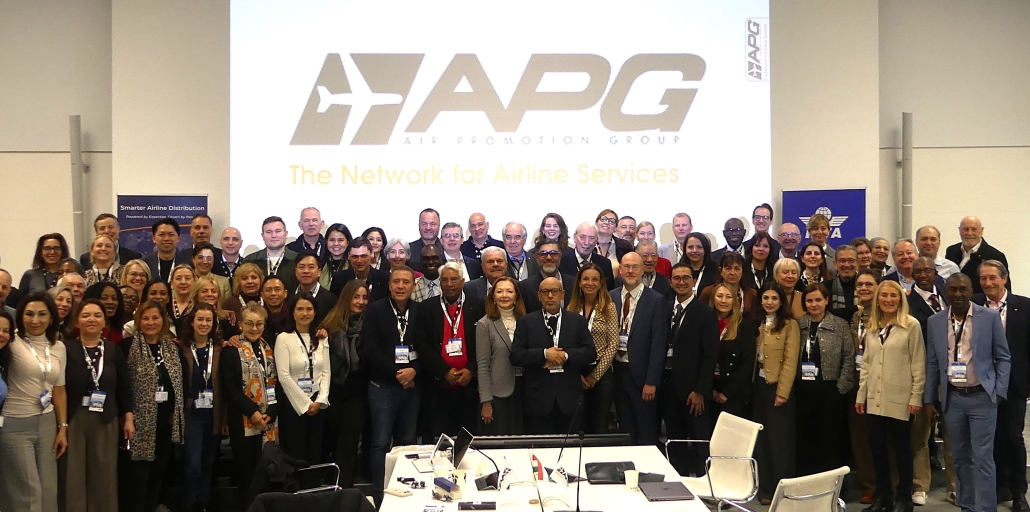
A large group of APG airline network professionals posing together at the 2026 Annual General Meeting (AGM) in Annecy, France

Today, this balance between experience and innovation continues to define APG’s approach.

Celebrating APG at 35 in Annecy

This year, during APG’s Annual General Meeting in Annecy, France, we came together to celebrate this important milestone.

As night fell, the celebration took to the sky with a specially choreographed drone show created to tell the APG story.

Through light, movement, and carefully designed formations, the drones illustrated the journey of APG, from its beginnings in 1991 to the global network it has become today, while also symbolizing the journey still ahead.

More than a celebration, the drone show reflected the spirit of APG itself: forward-looking, innovative, and conscious of its impact, even in the way we mark important milestones.

Reflections on 35 Years

“ Innovation has always been part of APG’s DNA. Whether through distribution solutions, interline services, or NDC technology, our goal has always been to anticipate industry needs while maintaining the strong relationships that remain at the heart of our business.


Sandrine de Saint Sauveur
President & CEO, APG Inc.

“ APG’s journey over the last 35 years has been built on strong relationships, entrepreneurial spirit, and a constant willingness to adapt to an evolving industry. What makes this anniversary especially meaningful is not only the scale of what APG has become, but the people across our global network who continue to shape its future every day.

Richard Burgess
Richard Burgess
President, APG Network

Written by
Fredi Aravena
Digital Content & Communications
18 June 2026
https://apg-ga.com/wp-content/uploads/2026/06/DSC5208-scaled.jpg 1240 2560 Fredi Aravena https://www.apg-ga.com/wp-content/uploads/2025/03/25apg-logo-340x156-1.png Fredi Aravena2026-06-18 00:27:092026-06-18 20:51:00APG at 35: A Journey of Growth, Innovation, and Connection

The End of the Distinction Between Low-Cost and Legacy Airlines

All, chronicles

This seems to be a fundamental trend. The models that were once so different between traditional carriers and low-cost carriers are increasingly being copied. It took almost 40 years for the two models to gradually come together, and in the future only the distinction between short-haul and long-haul flights will remain. We go back to the origins of air transport.

Long gone are the days when historical companies saw the arrival, with some condescension, not to say disdain, of new entrants who claimed to make a place for themselves in a universe that was, after all, quite closed. To do this, they had the absolute weapon: the ability to put on the market fares so low that they were impossible to achieve by traditional carriers, all with the same aircraft. The difference in product was certainly real; there were, and still are, strong constraints: increased density of cabins, the need to buy tickets well in advance, the obligation to pay, in addition to the transport itself, for almost all the often-essential extras, for example the carriage of luggage or onboard services, even the smallest ones.

The vast majority of the companies already established despised these intruders and predicted an uncertain future for them, to say the least. Except that their analysis was wrong and that, for a flight time of less than 3 hours, customers began to favour price, which was often half that of the traditional carriers. The difference was even greater for business passengers, on whom the companies made their profits. The gradual loss of this prestigious clientele, who refused to pay up to three or four times the price on the same destinations, made even the largest companies think seriously. They gradually adopted the same practices as low-cost airlines, even if these practices did not cover their costs. They then tried to group together in essentially cosmetic alliances, without necessarily having great success.

The losses accumulated in competing with low-cost airlines led many air transport giants to file for bankruptcy. It should be remembered that the three largest American carriers – United Airlines, Delta Air Lines and American Airlines – have all gone through the American-style bankruptcy filing called Chapter 11. To regain decent financial health, the major carriers had to make considerable savings. These were painful, and the staff of these companies paid the price: up to a 30% reduction in workforce across all continents. In fact, the strategy of traditional airlines was to lower their level of service and even their product offering in order to almost entirely copy low-cost airlines, all while displaying fares identical to those of their new competitors.

Only the low-cost airlines themselves had to face the demands of their customers, who began to balk at the sometimes abusive practices of their carriers. They started to invent new services to compete with the incumbent operators. This is how they opened their sales to travel agents, which they had stubbornly refused to do. They then moved into major airports, whereas their strategy had been to serve only secondary airports for reasons of cost and speed of turnaround, allowing them to make an additional rotation per day. Finally, they began to establish interline agreements with the major carriers, despite having previously been their fiercest enemies.

In short, gradually, each taking a step towards the other, the two models have been converging, at least for flights of less than 3 hours. But for long-haul flights, the situation is different. Since the end of the Covid-19 pandemic, airlines have noticed that customers are accepting fares much higher than those they were used to charging, provided they find a product superior to what had become the norm. As a result, airlines embarked on a strategy of improving their services, particularly on long-haul routes, helped by manufacturers who brought to market much more efficient aircraft capable of operating non-stop flights of unprecedented duration. They created an intermediate class, often called Premium Economy, intended to accommodate customers tired of the increasingly basic service in Economy Class.

And whether they like it or not, low-cost carriers wishing to enter the long-haul market will be forced to provide a product that is compatible with their passengers’ expectations.

Thus, we can predict that in the near future, the distinction will no longer be made between low-cost carriers and traditional airlines, but simply between short-haul and long-haul flights, each trying to differentiate itself in order to attract customers.

11 June 2026
https://apg-ga.com/wp-content/uploads/2025/03/25apg-jlb-chronicle-inner-800.png 232 800 Jean-Louis Baroux https://www.apg-ga.com/wp-content/uploads/2025/03/25apg-logo-340x156-1.png Jean-Louis Baroux2026-06-11 19:14:522026-06-11 21:10:18The End of the Distinction Between Low-Cost and Legacy Airlines

APG Appointed Passenger GSA for Vietnam Airlines in Saudi Arabia

All, news
Published: 09 June 2026

APG is pleased to announce its appointment as Passenger General Sales Agent (GSA) for Vietnam Airlines in Saudi Arabia.

APG already supports Vietnam Airlines across various markets and services within its global network. This latest mandate extends that collaboration into the Kingdom of Saudi Arabia, where APG will provide local sales and commercial representation services to support the airline’s growth and development in the market.

As Saudi Arabia continues to emerge as a key aviation and travel hub, this new agreement reflects Vietnam Airlines’ commitment to strengthening its presence in the region while benefiting from APG’s local expertise and industry relationships.

The mandate further reinforces APG’s role as a trusted commercial partner for airlines worldwide, delivering market representation, sales support, and business development services through its extensive global network.

We are proud to continue building on our successful relationship with Vietnam Airlines and look forward to supporting the airline’s ambitions in Saudi Arabia.

For more information about APG Passenger GSA services, visit our Passenger GSA Services page.

Written by
Fredi Aravena
Digital Content & Communications
9 June 2026
https://apg-ga.com/wp-content/uploads/2026/06/VN.jpg 695 1800 Fredi Aravena https://www.apg-ga.com/wp-content/uploads/2025/03/25apg-logo-340x156-1.png Fredi Aravena2026-06-09 00:09:522026-06-11 21:02:45APG Appointed Passenger GSA for Vietnam Airlines in Saudi Arabia

APG Appointed Passenger GSA for Sunrise Airways in Canada and the USA

All, news
Published: 29 May 2026

APG is pleased to announce its appointment as Passenger General Sales Agent (GSA) for Sunrise Airways in Canada and the United States.

Under this new partnership, APG will provide comprehensive sales and marketing representation to support Sunrise Airways’ commercial development and strengthen the airline’s presence across the North American market.

In addition to its Passenger GSA responsibilities, APG will also manage Sunrise Airways’ ARC and BSP services, delivering efficient ticketing, settlement and distribution solutions to enhance the airline’s engagement with the travel trade community.

Sunrise Airways is a leading Caribbean carrier, connecting key destinations across the Caribbean, North America and beyond. The airline plays an important role in facilitating regional connectivity and serving both business and leisure travellers throughout its network.

APG looks forward to working closely with Sunrise Airways and contributing to the airline’s continued growth and success in these important markets.

For more information about APG Passenger GSA services, visit our Passenger GSA Services page.

Written by
Fredi Aravena
Digital Content & Communications
8 June 2026
https://apg-ga.com/wp-content/uploads/2026/06/apg-gssa-sunriseairways.jpg 695 1800 Fredi Aravena https://www.apg-ga.com/wp-content/uploads/2025/03/25apg-logo-340x156-1.png Fredi Aravena2026-06-08 08:22:002026-06-06 00:27:12APG Appointed Passenger GSA for Sunrise Airways in Canada and the USA

Recent

  • APG Airlines Cargo and Himalaya Airlines Sign Interline Cargo Agreement
  • APG Appointed Passenger GSA for Ajet in Saudi Arabia
  • APG Inc President Sandrine de Saint Sauveur and APG Network President Richard Burgess celebrating with international airline partners at a global conference.APG at 35: A Journey of Growth, Innovation, and Connection
  • APG Appointed Passenger GSA for Vietnam Airlines in Saudi Arabia
  • APG Appointed Passenger GSA for Sunrise Airways in Canada and the USA
  • APG Appointed Passenger GSA in Morocco for TUI Group Airlines
  • Celebrating APG Day: One Network, One Spirit
  • APG Signs New Interline Cargo Agreement with Uzbekistan Airways
  • ITA Airways Now Available on APG Direct Connect
  • APG Airlines Welcomes Shenzhen Airlines

Previous

Media Contact

Frederick Despreaux
Frederick Despreaux
Media Relations
For media enquiries please email: media@apg-ga.com |  f.despreaux@apg-ga.com or submit your query to Media Relations via our online form

Company

About

Our team

Locations

Latest News


Services

Passenger

Cargo

WorldConnect

APG Academy

Information

Contact

Environmental, Social & Governance

Privacy Policy | Cookie Policy

Terms of Use

Latest

  • APG Airlines Cargo and Himalaya Airlines Sign Interline Cargo Agreement
  • APG Appointed Passenger GSA for Ajet in Saudi Arabia
  • APG Inc President Sandrine de Saint Sauveur and APG Network President Richard Burgess celebrating with international airline partners at a global conference.APG at 35: A Journey of Growth, Innovation, and Connection
© COPYRIGHT - APG Air Promotion Group. ALL RIGHTS RESERVED.
  • Link to LinkedIn
  • Link to Facebook
  • Link to X
  • Link to Youtube
Scroll to top Scroll to top Scroll to top